November 2026 Book Recommendation
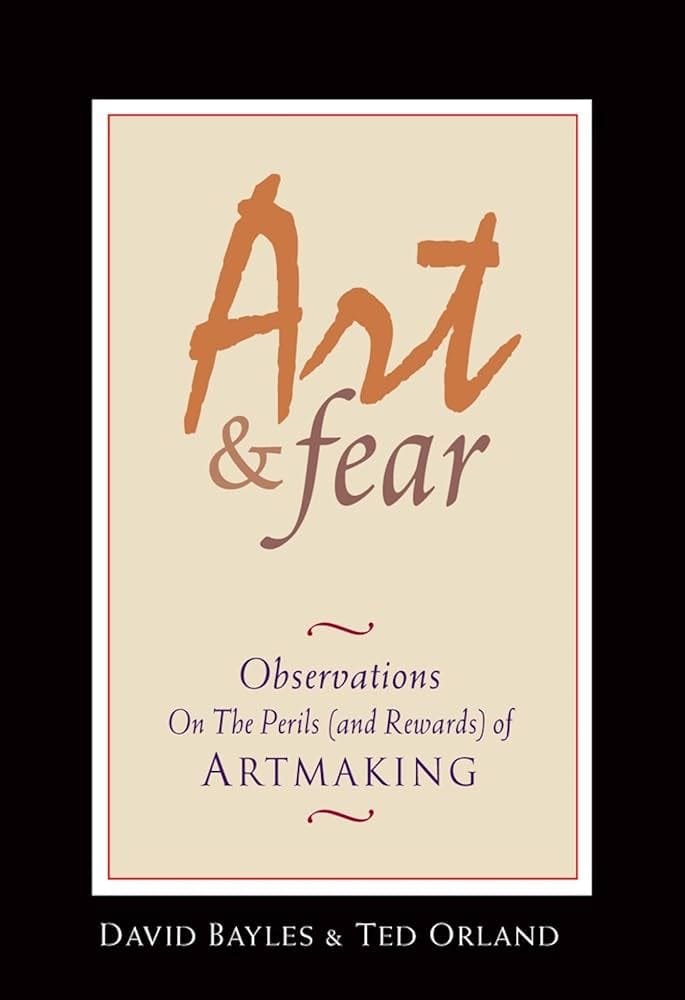
Have you ever had a book that you vaguely remember reading, but you’re just not sure? For me, that book was Art & Fear: Observations on the Perils (and Rewards) of Artmaking by David Bayles and Ted Orland. I wasn’t sure I’d read this book, so I decided to read it and it felt both new and familiar that’s why I decided to use it as my recommended read for December.
It’s about 120 pages so it’s short, but whether you read it all in an afternoon or go through it slowly reading just a couple pages at a time, it might change how you spend the rest of this writing year and the next.
Both of the authors are working artists, and everything they say applies to any kind of process of making something.
Here are three takeaways.
1) Volume beats perfectionism.
The book tells the story of a ceramics teacher who split his class in two. One half would be graded on quantity; fifty pounds of pots earned an A. The other half only had to make one pot, but it had to be perfect.
And guess which group made the best work.
The quantity group. While the quantity group was busy making pot after pot and learning from each mistake, the quality group sat around theorizing about perfection and had little to show for it.
Writers sometimes find themselves doing this as well. They’ll polish Chapter One for the tenth, fifteenth, twentieth time instead of writing Chapter Two. They’ll write a scene over and over and over again instead of writing the next scene, then the next.
Your skills grow each time you finish something, whether it’s a sentence, whether it’s a scene, whether it’s a book. Make your goal about doing it once and then doing it again.
2) Most of your work is practice, and that’s the point.
“Acceptance means having your work counted as the real thing; approval means having people like it. It is not unusual to receive one without the other.” fromArt & Fear
Most of what you write won’t be your best. The authors say that this isn’t failure. That’s how it works. The bulk of your work exists to teach you how to make the few pieces that will truly shine. It’s not for you to figure out what those pieces will be, it’s for you to give them life so that they can exist.
I hope this frees you. Because once you accept that most of the drafts, most of the work, most of what you do is just practice, you can stop worrying about everything being brilliant. Nothing is “wasted.” There’s no wasted story. There’s no wasted effort. It taught you how to do the next one.
3) Quitting is the real danger, not failing.
A bad draft, rejection, terrible reviews, a book no one reads, is not the end (however, it may feel that way at the time).
The only thing that can stop you is…you. You walking away for good. The authors make a very useful distinction. They say stopping is normal. Life gets busy. Projects stall, however quitting is different. Quitting is deciding not to start again.
So if you’ve had a slow week, a slow month, or even a year, you haven’t failed. You’ve paused. Pick up where you left off. Start again.
That’s what professionals do.
Bonus: If/When you get stuck
“As a practical matter, ideas and methods that work usually continue to work. If you were working smoothly and now you are stuck, chances are you unnecessarily altered some approach that was already working perfectly well.” from Art & Fear
One of the authors shares about how, for years, he’d set aside daytimes for artmaking and evenings for writing. And at some point, he reversed that schedule. Months passed before he realized that the writing had dried up, not for lack of ideas, but because it turned out the process he had before worked and he’d upended it.
I had something similar happen to me. I was having trouble with my writing computer and didn’t feel I had the time to fix it so I tried to use my business computer as also my writing computer and it was disasterous. I quickly got my writing computer back in working order and went back to the method that works for me.
So, if you find yourself stuck, you may want to look at what you’ve changed and adjust it.
Art &Fear is a short book that’s been shared and passed around for years. It carries a big message —making things can be scary, and that’s also the fun part.
Get your copy – Retailer link Bookshop.org
Get your copy – Public library link https://search.worldcat.org/